Written for owners of Singapore businesses who have been told their website needs schema markup to show up in AI answers. Read this before you pay for it.
The short answer
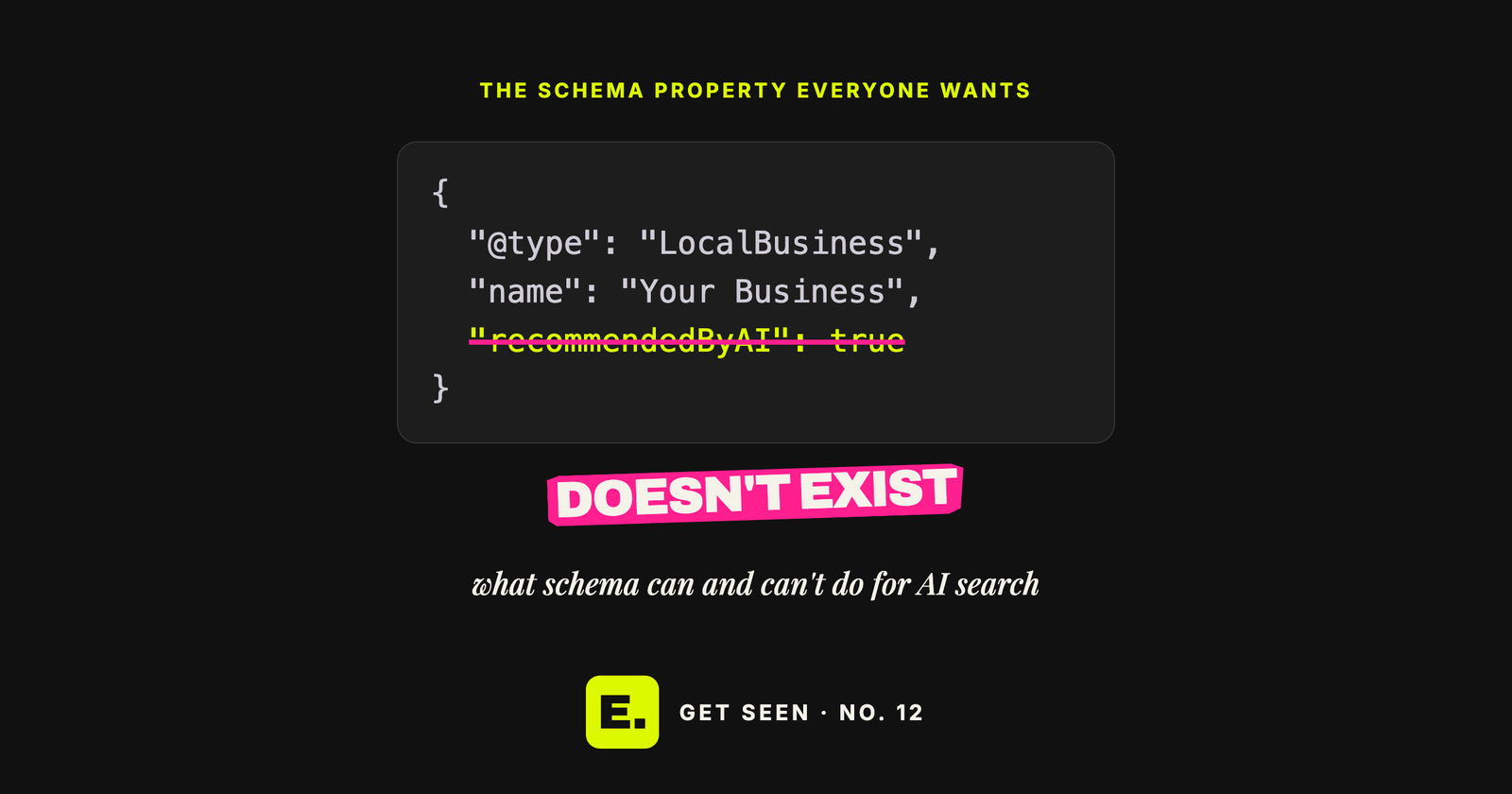
Schema markup for AI search is useful housekeeping, not a way to get recommended. Google says there is no special schema you need to add to appear in its AI answers, and the largest public before-and-after test found that adding schema produced no real lift in AI citations.
Keep the schema your website plugin already adds for free. Don’t pay a monthly fee for more of it. Spend that money on being talked about and on answering your customers’ questions better than anyone else.
Key takeaways
- Google says no special schema is needed for AI Overviews or AI Mode, and no special “AI text files” either.
- Ahrefs tracked 1,885 pages that added schema against 4,000 that didn’t. AI citations didn’t rise on any platform.
- “Cited pages have more schema” is a correlation. Well-run websites have schema and everything else that gets them named.
- FAQ schema lost its main payoff when Google stopped showing FAQ results on 7 May 2026.
- Schema still helps machines read your page, and it can earn rich results in normal Google search. That’s worth keeping, not worth a retainer.
What schema markup is, in plain words
Schema markup is a set of labels hidden in your website’s code. It tells a machine what each piece of information is: this is our address, these are our opening hours, this is the price, this person wrote the article. You don’t see it on the page. Google and other search tools read it.
It was created in 2011, when Google, Bing and Yahoo agreed on a shared vocabulary so they could read websites the same way. That’s still what it does. It describes what a page already says. It doesn’t add anything the page doesn’t say, and it doesn’t make anyone recommend you.
Said plainly
Schema is a label on the box. It tells the AI what’s inside. It doesn’t give the AI a reason to pick your box over anyone else’s.
What’s being sold as “schema for AI”
Since AI answers arrived, schema has been repackaged. Singapore business owners are now being offered:
- “AI schema packages” that add more types of markup and promise more AI citations.
- Monthly “structured data” retainers for work a plugin does in a minute.
- FAQ schema as a way to get your questions into AI answers.
- “Entity graphs” that link your business, your people and your pages in code.
- llms.txt files, a newer idea: a plain text file that tells AI tools which pages matter.
Some of these do something useful. None of them is what decides whether ChatGPT or Google’s AI names your business, and the evidence below shows why.
What Google and Bing actually say about schema and AI
Start with the companies that build the AI answers. Google’s own guidance for site owners on AI Overviews and AI Mode is direct: you don’t need to create new machine-readable files, AI text files or markup to appear in these features, and there is “no special schema.org structured data that you need to add.”
Google went further in June 2026. It published guidance on SEO advice from outside companies, including advice sold as AEO or GEO, and told site owners to check it against Google’s official guidance before acting. It also reminded them that no tool or service can guarantee results.
Here is the fair side. In March 2025, Microsoft’s Bing said schema helps its AI understand content, and in April 2025 Google said structured data gives pages an advantage in search results. That’s why schema is worth keeping. But understanding a page isn’t the same as recommending the business behind it. OpenAI, Anthropic and Perplexity, the companies behind ChatGPT, Claude and Perplexity, have never said publicly whether they use a page’s schema at all.
Seven schema claims, checked
These are the claims we hear most often from owners who’ve been pitched. We check each one against what the platforms say and what the best available test found.
“You need schema to appear in AI answers.”
FalseGoogle says there is no special schema you need to add for AI Overviews or AI Mode. Forum threads and videos with no special markup are quoted in AI answers every day.
“Adding schema gets you cited more by AI.”
Not supportedAhrefs tracked 1,885 pages that added schema against 4,000 matched pages that didn’t. Citations didn’t rise in ChatGPT, Google AI Mode or AI Overviews.
“Cited pages have more schema, so schema works.”
MisleadingPages cited by AI were about three times more likely to have schema. That tells you well-run sites use schema. It doesn’t tell you schema is why they were cited.
“FAQ schema gets your answers into AI.”
Out of dateGoogle stopped showing FAQ results in search on 7 May 2026, and there’s no evidence the markup itself earns AI citations. Useful questions and answers on the page still help readers.
“An entity graph makes the AI trust you.”
MisleadingSEO plugins such as Yoast already build this for you, free. Our own site has one, and Google’s AI still didn’t know our name.
“You need an llms.txt file for AI.”
Not neededGoogle lists “AI text files” among the things you don’t need. The idea was only proposed in September 2024, long after AI tools had started reading the web.
“Schema helps Google understand your page.”
True, butIt does, and it can earn rich results in normal Google search. Google cites Nestlé pages with rich results getting an 82% higher click-through rate. That’s about classic search results, not about being named in AI answers.
The test that settles it: 1,885 pages that added schema
Most claims about schema and AI come from looking at pages that are already cited and noticing they have schema. That can’t tell you what caused what. The better question is: what happens when a page adds schema?
Ahrefs answered it. Between August 2025 and March 2026, it tracked 1,885 web pages that added schema, and compared them with 4,000 matched pages that didn’t. Then it measured how often each page was cited by ChatGPT, Google’s AI Mode and Google’s AI Overviews in the 30 days before and after.
- ChatGPTCitations didn’t grow.
- Google AI ModeNo real growth. The raw numbers looked like a 43% jump, but the pages that didn’t add schema rose almost as much. AI Mode was simply growing for everyone.
- Google AI OverviewsA small drop of 4.6% compared with the other pages. Ahrefs couldn’t pin the cause on schema, and neither should anyone else.
Ahrefs’ own summary: adding schema “produced no major uplift in citations on any platform.”
The honest limit
The pages in this test were already being cited by AI. It shows that adding schema doesn’t push a visible page higher. It doesn’t directly test a brand-new page nobody has cited yet. For that page, the question is whether anyone talks about it and whether it answers anything better than the pages already cited, which is exactly what the rest of this post is about.
Why “cited pages have schema” fools people
Almost every restaurant with a Michelin star has cloth napkins. Buying cloth napkins won’t get you a star. The napkins come with a certain kind of restaurant, and so does the star.
Schema works the same way. Big publishers, well-known brands and established clinics tend to have schema, editors, real authors, links from other sites, press mentions, and years of reviews. When AI cites them, schema is in the picture, but it’s the napkin. The +43% in the Ahrefs data is the same trap in numbers: until you compare with pages that didn’t change, any rising trend looks like proof.
Our own evidence: same schema, very different results
We can show this on real websites we work on.
First, our own. Our website runs on WordPress with the Yoast SEO plugin, and Yoast outputs a full linked “entity graph” on every page without anyone writing a line of it. This is what it produces for one of our blog posts:
What our plugin outputs, automatically
"@graph": [
  { "@type": "Article",  "@id": "…/#article" },
  { "@type": "WebPage",  "@id": "…/best-visibility-agency-singapore/" },
  { "@type": "BreadcrumbList" },
  { "@type": "WebSite",  "@id": "https://getgetbrandexposure.com/#website" },
  { "@type": ["Organization", "ProfessionalService"],
    "@id": "https://getgetbrandexposure.com/#organization" },
  { "@type": "Person" }
]
Trimmed from the live page, 25 September 2026. The same linked structure that some schema guides call “advanced”.
On 24 September 2026, we asked Google what Get Brand Exposure is. Its AI answered the general phrase “brand exposure” and didn’t mention our business. We had perfect schema, and it still didn’t name us. We opened our offer to the public this month, and a new name takes time and steady work to build momentum. The markup can’t skip that step.
Second, a chiropractic clinic in Singapore whose guides we publish. Every guide uses the same markup template: article, author, organisation, condition and FAQ, identical on every page.
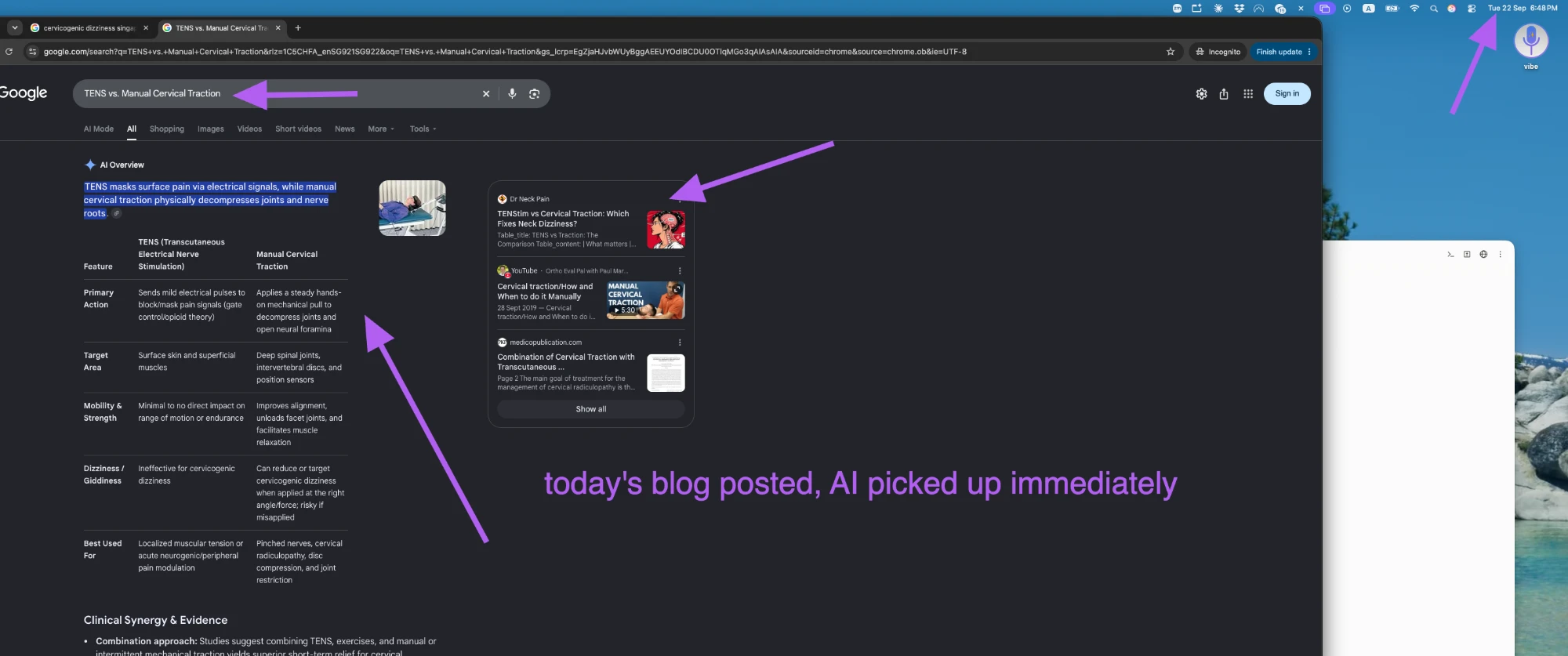
That guide answered one narrow question clearly, and Google’s AI quoted it within hours. The clinic’s broad question, “the best neck pain specialist”, took weeks before Google’s AI listed the clinic second on 17 September. The markup was identical on both. What differed was the question each page answered and how many other places were talking about the clinic by then.
Why the pro-schema articles you’ve read may be out of date
Many of the articles telling you schema “transforms” AI visibility were written before two things happened in May 2026. Google stopped showing FAQ results on 7 May, and Ahrefs published its before-and-after test that same month. Check the date on any schema advice you’re given, and see whether its numbers match pages that didn’t change. If they don’t, you’re looking at napkins.
What schema is still good for
None of this means you should remove your schema. It’s cheap, it’s usually automatic, and it has real jobs. The question is whether a particular piece is worth paying for.
| Your situation | Worth it? | Why |
|---|---|---|
| Online shop with products, prices and stock | Yes | Product markup feeds shopping results and price displays in normal Google search. |
| Events, job listings, recipes | Yes, where eligible | These map to specific Google search features you can see and measure. |
| Local service business (clinic, salon, studio) | Keep what your plugin adds | Accurate name, address, hours and services help machines read you. They won’t fix weak pages or a quiet reputation. |
| FAQ schema added for visibility | Low | The FAQ result is gone from Google search, and there’s no evidence the markup earns AI citations. |
| An “AI schema package” or monthly markup retainer | No | No platform has confirmed a path from extra markup to AI citations, and the best test found none. |
The only schema a local business needs
Your plugin does most of this in a minute.
- Your business details, correctFill in your name, address, phone, opening hours, website and logo. Yoast, Rank Math and similar plugins have a settings page for exactly this.
- The same details everywhereMake them match your Google Business Profile and your directory listings word for word.
- Nothing hidden that isn’t on the pageGoogle asks that your structured data matches the visible text. Don’t put claims in the code that your page doesn’t make.
Done? That’s your schema sorted. Nothing here needs a monthly fee.
Where to spend instead
If schema isn’t what gets a business named, what is? In our work, the same two things do the heavy lifting, and they compound when you do both.
Other people talking about you
News pieces, videos, podcasts, other people’s lists and forum threads that name your business. In Ahrefs’ study of 75,000 brands, mentions on YouTube and across other websites had the strongest link to being named by AI.
The best answer on your own site
Your site should hold a clear, specific answer to each question customers ask, from “something’s wrong” to “who should I pick”. The best answers come from real experience and answer in the first lines.
We set out all eight checks in our AI search visibility checklist for Singapore businesses, including the ten-minute technical check that covers schema. The first driver is what MultiCasting, our publishing service, does every month: one topic, turned into articles, videos, podcasts, and news pieces across hundreds of sites. For the second, see which kinds of page ChatGPT quotes most, and for both together, the four steps to get a business mentioned in ChatGPT.
Not sure whether you’re being sold schema as AI visibility? Tick whatever applies.
1-minute self-check
Are you paying for the wrong lever?
Tick any that sound like you. A result appears as soon as one is true.
Your result will show here.
Want to see what AI actually says about you? Get My Free AI Visibility Audit ↗
You may be paying monthly for a one-off job
Schema is set once and checked now and then. Before you renew, see whether AI names you at all, and for which questions.
See What AI Says About My Business ↗
If you’re comparing suppliers, here’s what AI search agencies in Singapore actually deliver for the fee.
That advice is out of date
Google stopped showing FAQ results on 7 May 2026 and says no AI text files are needed. The audit shows which questions you actually lose, so you fix those instead.
Get My Free AI Visibility Audit ↗
Then work through the eight checks that do move the answer.
Then schema was never the problem
You have the labels. What’s missing is other people talking about you and the best answer to each customer question. The audit shows who gets named instead and why.
See Who AI Names Instead of Me ↗
MultiCasting is how we get a business talked about in the places AI reads.
Check it once, then stop worrying
If your site runs Yoast, Rank Math or a similar plugin, you almost certainly have the basics. Fill in the business details page, and you’re done. Then look at what actually decides AI answers.
More than one, so start with the facts
Before you change or cancel anything, see what AI actually says about your business, question by question, on five assistants. Then spend where the gaps are.
Questions owners ask
Does schema markup help AI search?
It helps machines read your page, but there’s no evidence it gets you cited more. Google says no special schema is needed for its AI features, and a test of 1,885 pages that added schema found no citation lift in ChatGPT, Google AI Mode or AI Overviews.
Should I remove the schema on my website?
No. Keep what your plugin adds. It’s free, it keeps your business details accurate for machines, and it can earn rich results in normal Google search. Just don’t pay extra for more of it in the hope of AI citations.
Is FAQ schema still worth adding?
Not for visibility. Google stopped showing FAQ results on 7 May 2026. Clear questions and answers on the page still help readers, and visible content matters most.
Do I need an llms.txt file?
No. Google says you don’t need AI text files to appear in its AI features. The idea was proposed in September 2024, and no major AI company has confirmed using it to decide who to name.
Does Bing or Copilot use schema?
Microsoft has said schema helps its systems understand content. Understanding a page isn’t the same as recommending the business behind it. OpenAI, Anthropic and Perplexity haven’t said whether they use schema at all.
What schema does a small business actually need?
Your business details, filled in correctly in your SEO plugin: name, address, phone, opening hours, website and logo, matching your Google Business Profile. That takes minutes and needs no monthly fee.
See what AI actually says about you.
Before you pay for more markup, find out which questions you lose and who gets named instead. Free, done by hand, five AI assistants.
Get My Free AI Visibility Audit ↗References
- Google Search Central. AI features and your website. Last updated 10 December 2025. “No special schema.org structured data that you need to add.” developers.google.com
- Google Search Central. Google Search’s guidance on using third-party SEO tools, services, and advice, 5 June 2026. developers.google.com
- Google Search Central. Documentation updates: FAQ rich result no longer shown in Google Search from 7 May 2026. developers.google.com
- Google Search Central. Introduction to structured data (Nestlé, 82% higher click-through rate for rich results). developers.google.com
- Ahrefs. We Tracked 1,885 Pages Adding Schema. AI Citations Barely Moved. May 2026. ahrefs.com
- Ahrefs. Top Brand Visibility Factors in ChatGPT, AI Mode, and AI Overviews (75,000 brands studied). ahrefs.com
- Search Engine Land. Schema markup and AI search: no hype. Statements from Google (April 2025) and Microsoft Bing (March 2025); no public disclosure from OpenAI, Anthropic or Perplexity. searchengineland.com
- Get Brand Exposure. Live schema output of getbrandexposure.com and drneckpain.com, checked 25 September 2026. Google captures of 22 and 24 September 2026, private window.
Platform guidance and AI behaviour change often. This post reflects what Google, Microsoft and the studies cited had published by 25 September 2026. Nothing here is legal advice.